

Leading Beyond Disruption: Mastering Transformation and Uncertainty in the Age of AI and Change
Četvrtak, 22.10.2026.
Hotel Pical Poreč
Ponedjeljak, 19.10.2026.
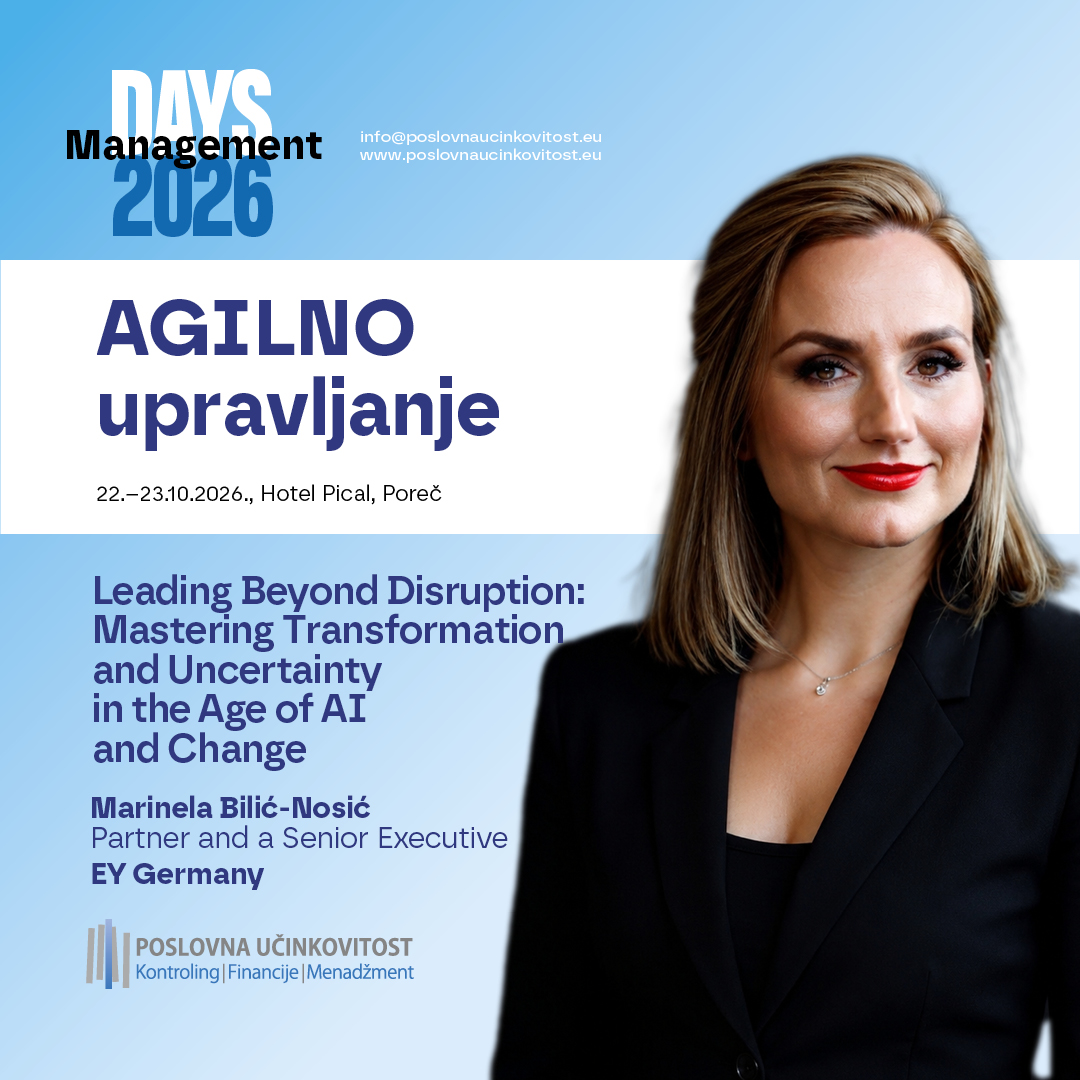
Radionica je dio programa MANAGEMENT DAYS 2026.
The defining challenge for leaders today is not simply technological disruption. It is the convergence of multiple transformations occurring simultaneously: artificial intelligence, geopolitical uncertainty, economic volatility, societal change, and evolving workforce expectations. In such an environment, leadership becomes less about predicting the future and more about building organizations that can adapt to whatever future emerges. Organizations that succeed will not necessarily be those with access to the most advanced technologies. They will be those whose leaders can combine technological capabilities with human judgment, resilience, adaptability, trust, and a compelling vision for the future. The challenge for today's leaders is therefore not simply to understand AI, but to lead transformation in a world where uncertainty itself has become a permanent feature of the business landscape.
Introduction
Organizations today are navigating an era of unprecedented complexity. Artificial Intelligence is transforming industries, business models, and the nature of work, while at the same time leaders face growing geopolitical uncertainty, economic volatility, regulatory shifts, and societal change. Together, these forces are creating a business environment characterized by rapid disruption, increasing interdependence, and a level of uncertainty that challenges traditional leadership approaches.
In this context, leadership is no longer simply about managing performance and executing strategy. It is about helping organizations adapt, learn, and thrive amid continuous transformation.
This executive program explores the intersection of leadership, organizational transformation, and artificial intelligence within a broader global context. Rather than focusing primarily on the technology itself, the course examines how leaders can respond to a world in which intelligence is increasingly accessible, geopolitical dynamics are reshaping markets, and organizations must become more resilient, agile, and future-ready.
Throughout the day, participants will follow a structured journey that addresses five critical questions:
What is happening in the world around us?
We begin by exploring the major forces shaping today's business environment. Participants will examine the rise of Artificial Intelligence alongside broader global trends, including geopolitical tensions, technological competition, regulatory developments, economic uncertainty, and shifting workforce expectations. Together, these trends are redefining how organizations compete and create value.
How will these disruptions transform our business?
The second part focuses on the strategic implications of AI. Participants will learn how organizations create value through automation, augmentation, innovation, and business model transformation. At the same time, they will consider how geopolitical developments, supply chain disruptions, and regulatory fragmentation influence strategic decision-making and organizational resilience.
How must leadership evolve to succeed in this environment?
As complexity increases and certainty decreases, traditional leadership models become less effective. Participants will explore the evolution of leadership from transactional and command-and-control approaches toward transformational, servant, authentic, and adaptive leadership models. Special attention will be given to leading through ambiguity, managing competing priorities, and creating direction in environments where no clear roadmap exists.
How do we bring people along?
Successful transformation is ultimately a human challenge. This section examines organizational culture, employee engagement, change management, trust, governance, and responsible AI. Participants will learn how leaders can foster innovation while maintaining psychological safety, accountability, and organizational cohesion during periods of significant change
What actions should we take next?
The day concludes with a practical workshop in which participants assess their organization's readiness, identify strategic opportunities, and develop an actionable roadmap for AI-enabled transformation. The focus is on translating insights into concrete leadership actions that strengthen both competitiveness and resilience.
Learning Outcomes
By the end of the program, participants will be able to:
- Understand the strategic implications of AI and geopolitical change for organizations and industries.
- Assess how global uncertainty influences business strategy, innovation, and organizational resilience.
- Identify opportunities for AI-driven transformation and value creation.
- Apply modern leadership approaches in complex and rapidly changing environments.
- Lead organizational change and foster an AI-ready culture.
- Balance innovation with ethics, governance, accountability, and risk management.
- Develop a practical roadmap for sustainable transformation.
WORKSHOP SCHEDULE
10:30 – 11:30 | The AI Revolution and a New Era of Uncertainty
- The Convergence of Disruptive Forces: AI, geopolitical tensions, economic volatility, demographic shifts, and sustainability pressures.
- AI as a General-Purpose Technology: Why AI may have an impact comparable to electricity, the internet, and industrialization.
- Capabilities and Limitations of AI: What AI can and cannot do today and the implications for decision-making.
- Strategic Implications: How technological and geopolitical shifts are reshaping industries, competition, and global value chains.
Learning Objectives: Understand the major forces shaping today's business environment and recognize AI as part of a broader transformation landscape.
11:30 – 11:45 | Coffee Break
11:45 – 13:15 | Business Transformation in the Age of AI
- AI Value Creation Framework: Automation, augmentation, innovation, and business model reinvention.
- Redesigning Business Processes: Moving from efficiency gains to enterprise transformation.
- Strategic Resilience: Managing supply chain risks, regulatory uncertainty, and technological dependencies.
- New Sources of Competitive Advantage: Agility, learning speed, ecosystem partnerships, and human-AI collaboration.
Learning Objectives: Understand how organizations can create value through AI while strengthening resilience in an increasingly uncertain world.
13:15 – 14:15 | Lunch Break
14:15 – 15:00 | Leadership in the AI Era – From Command & Control to Adaptive Leadership
- The Evolution of Leadership: From transactional leadership to transformational, servant, authentic, and adaptive leadership models.
- Leading in Complexity: Navigating ambiguity, competing priorities, and constant disruption through systems thinking and experimentation.
- Human-Centered Leadership: Building trust, psychological safety, empathy, and engagement during periods of uncertainty and change.
- The Future Role of Leaders: Combining human judgment, ethical responsibility, and purpose with AI-enabled insights and decision support.
Learning Objectives: Understand how leadership models must evolve to address both technological disruption and increasing global uncertainty.
15:00 – 15:45 | Leading Organizational Change and Building an AI-Ready Culture
- Why Transformations Fail: Organizational inertia, change fatigue, leadership misalignment, and cultural barriers.
- Managing Human Reactions to Change: Addressing fear, uncertainty, resistance, and skills transformation.
- Building Organizational Resilience: Creating a culture of learning, adaptability, experimentation, and collaboration.
- Governance and Responsible Leadership: AI governance, ethics, risk management, compliance, and stakeholder trust.
Learning Objectives: Learn how to create the organizational conditions that enable successful transformation and long-term resilience.
15:45 – 16:00 | Coffee Break
16:00 – 17:30 | Executive Workshop – Building an AI and Transformation Roadmap
- Assessing Organizational Readiness: Evaluating AI maturity, leadership alignment, culture, resilience, and governance.
- Identifying Strategic Opportunities: Mapping quick wins, strategic initiatives, and transformational opportunities.
- Stakeholder and Risk Analysis: Identifying key stakeholders, sources of resistance, and external uncertainties.
- Creating a 12-Month Leadership Roadmap: Defining priorities, capability development, governance measures, and success indicators.
Learning Objectives: Translate the day's insights into a practical roadmap that balances innovation, resilience, and sustainable transformation.
OPCIJE SUDJELOVANJA I PRIJAVE
A. Menadžerska konferencija, 23.10.2026.
(kotizacija: 525,00 EUR + PDV)
B. Radionica, 22.10.2026.
(kotizacija: 475,00 EUR + PDV)
C. Menadžerska konferencija i radionica, 22. i 23.10.2026.
(kotizacija: 900,00 EUR + PDV)
PONUDA SMJEŠTAJA
Za sve sudionike naših događaja, uz obavezno rezerviranje putem linka MANAGEMENT DAYS 2026*, osigurana je posebna cijena smještaja u sljedećem hotelu**:
22.10.2026-25.10.2026.
1 do 4 noćenja - 205 EUR po noćenju single use
1 do 4 noćenja - 215 EUR po noćenju double use
Napomene:
* promo kod aktivan je od 21.1.2026., do trenutka dok ima slobodnih smještajnih kapaciteta u navedenim hotelima (kontakt za informacije: reservations@valamar.com)
** u slučaju da niste bili u mogućnosti rezervirati smještaj u navedenim hotelima, molimo Vas obratite se nama na +385 (0)1 23 04 571.
Molimo vas da na radionicu dođete najmanje 15 minuta prije početka radi registracije i preuzimanja materijala.

Marinela Bilić-Nosić is Partner at EY Germany and a senior executive with more than 20 years of international experience in financial services, governance, risk, regulatory transformation, and technology-driven change.
Prior to joining EY, she held senior leadership and board-level positions at Commerzbank, Deutsche Bank, CAPCO and IBM Consulting, including serving as a Chief Risk Officer and BaFin-approved board member. Throughout her career, she has advised leading financial institutions, regulators, and central banks across Europe, Ukraine and the United States on large-scale transformation, governance, risk, compliance, and (technical) transformation initiatives.
Today, Marinela partners with boards and executive leadership teams to drive strategic transformation initiatives, empowering organizations to enhance governance, resilience, and competitiveness amid disruption, shifting regulations, and rapid technological advancements.
She is a trained bank clerk and holds master's degrees from prestigious institutions including the Frankfurt School of Finance and the University of St. Gallen. Marinela is also recognized as a managing director under §25c KWG and holds international certification as a board member.

Julia Temizkan is a Director in EY Technology Consulting with more than 10 years of experience leading AI, data, and business transformation initiatives. She specializes in generative AI, AI operating models, and enterprise-scale AI adoption in regulated industries. Before joining EY, she held several leadership roles at IBM Consulting, including Practice Lead for AI & Data in Banking. Julia holds a Master's degree in Strategic Sales Management from ESB Business School Reutlingen.

Christina Rohschürmann is a Director in EY Technology Consulting with 14 years of experience at the intersection of business, technology, and regulation in the financial services industry. She focuses on AI-enabled transformation and the application of AI in highly regulated environments, particularly Financial Crime, compliance, and banking. Before joining EY, Christina held several leadership positions at IBM Consulting, where she built and led interdisciplinary teams and advised major European banks on complex transformation programs. She holds a Master’s degree in Business Psychology and is currently pursuing a Doctor of Business Administration at Middlesex University, researching the application of Artificial Intelligence in Anti-Money Laundering processes.